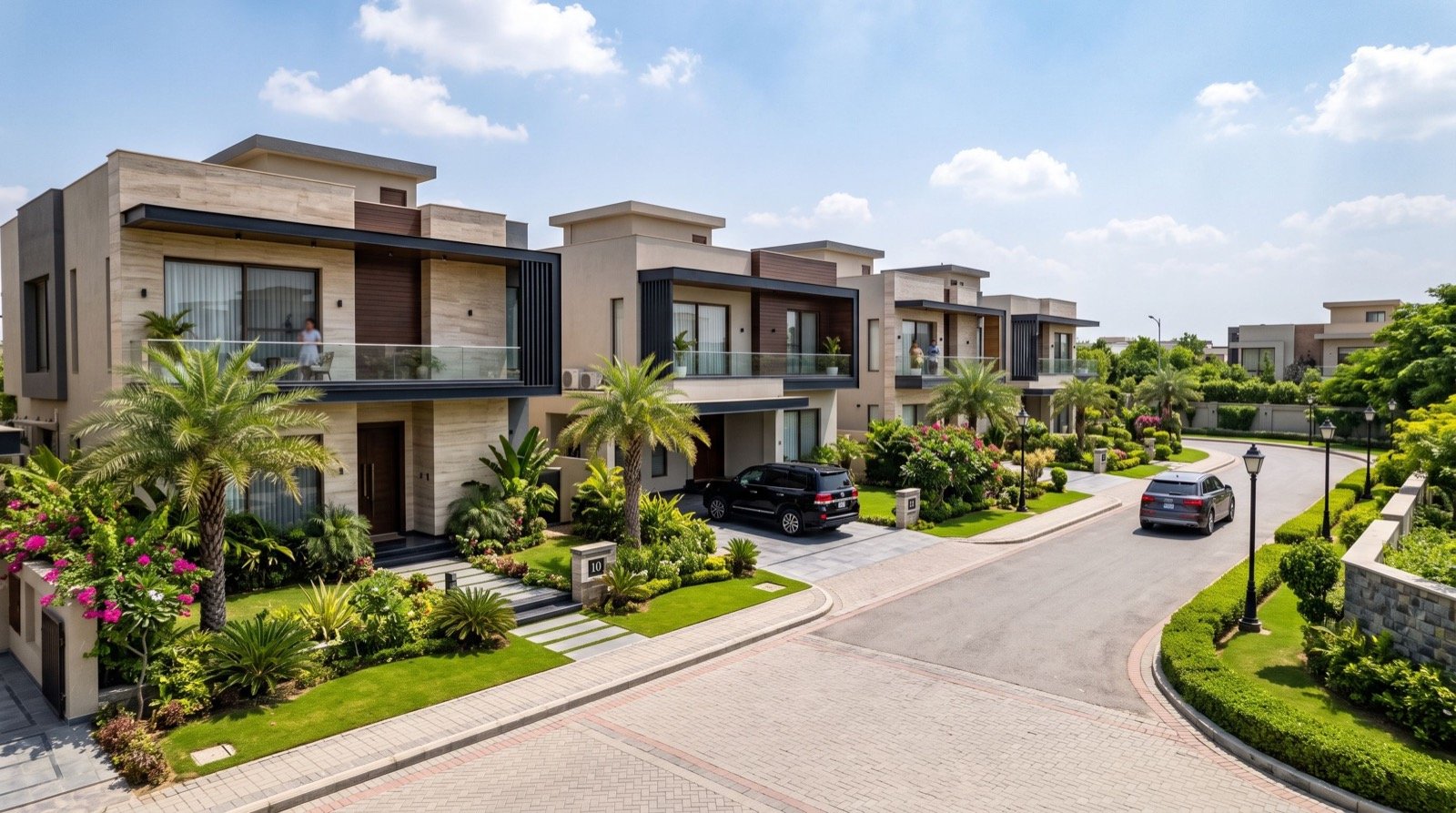
Islamabad’s skyline is changing faster than almost anyone predicted a decade ago, and much of that change is being driven by one trend: high rise plots in Islamabad have become the practical way for both end-users and investors to secure a foothold in the capital’s best corridors. Usable land is finite, demand keeps climbing every year, and building upward has become the obvious answer to both problems at once. If you are weighing up a purchase in 2026, this guide walks through what high-rise plots actually are, what drives their value, and how to buy one with confidence instead of guesswork.
Unlike a traditional five-marla or ten-marla residential plot, a high-rise plot is zoned specifically for multi-storey apartment blocks or mixed-use towers. That zoning changes the economics completely. Instead of one family on one plot, a developer can eventually house dozens of households or several floors of offices and retail on the same footprint, which is exactly why these plots carry a different kind of long-term value for an early buyer.
Why High Rise Plots in Islamabad Are Gaining Momentum in 2026
Three forces are pushing this trend at once: a growing population within Islamabad’s administrative sectors, rising construction costs that make vertical development more efficient per square foot, and a buyer base that increasingly wants secure, amenity-rich living without a long commute. Add in improving road networks linking the capital to Rawalpindi, and corridors that were once considered the edge of the city are now firmly inside the growth zone.
For a buyer, that momentum matters because it tends to show up first in land prices, well before it shows up in finished apartment prices. Getting into a well-zoned high-rise plot early is, in practice, how a lot of the strongest returns in this segment have been made over the last few cycles.
What Exactly Is a High Rise Plot, and Who Is It For?
A high-rise plot is best understood as a piece of land purchased with future vertical construction in mind, rather than a house. Buyers generally fall into two camps: developers and builder-investors who plan to construct and sell units, and longer-horizon investors who buy the land itself and either hold it or partner with a developer later.
- First-time land investors looking for a lower entry point than a finished apartment.
- Overseas Pakistanis who want capital growth without managing a construction project themselves.
- Small developers seeking plots that are already zoned correctly, saving months of approval delays.
- Families planning to eventually build a multi-unit property for rental income from relatives’ households.
Location Factors That Actually Drive Value
Not every high-rise plot appreciates at the same rate, and location remains the single biggest variable. Proximity to main boulevards, planned metro or BRT extensions, commercial hubs, and the airport corridor all tend to push values upward faster than plots tucked away from major arteries.
It also helps to look at what is being built around a plot right now, not just today’s road map. A cluster of new towers, schools, and retail nearby is usually a reliable signal that the surrounding land is about to re-rate upward, often before the official master plan documents catch up with reality on the ground.
A good way to benchmark any opportunity you are considering is to study a well-documented example such as High Rise Plots in Islamabad, which lays out plot sizes, pricing, and amenities clearly enough to use as a comparison point against any other scheme you come across during your search.
Legal Approvals and Due Diligence Before You Sign Anything
High-rise zoning only has value if it is legally recognised. Before committing any funds, buyers should confirm that the scheme has a valid No Objection Certificate and sits within the jurisdiction of the Capital Development Authority, which governs land use and building approvals across Islamabad. The CDA publishes zoning classifications and approved sector plans, and cross-checking a plot’s file number against that record is one of the simplest ways to avoid an expensive mistake.
It is also worth requesting the developer’s building-height approval specifically, since a plot can be legally owned yet still lack sign-off for the number of floors a buyer is assuming will eventually be built.
Comparing Your Options: A Quick Snapshot
| Plot Type | Typical Buyer | Return Horizon | Key Risk |
|---|---|---|---|
| High-rise plot | Investors, small developers | 3–7 years | Approval and construction delays |
| Residential plot | Families building a home | 5–10 years | Slower capital growth |
| Commercial plot | Income-focused investors | 5–8 years | Higher entry cost |
Affordable Private Housing Societies in Rawalpindi: The Wider Picture
High-rise opportunities in Islamabad rarely exist in isolation from what is happening just across the city line. A growing number of buyers now compare capital-side plots against Affordable Private Housing Societies rawalpindi, where lower entry prices and flexible instalment plans make it easier to diversify a portfolio across both cities rather than concentrating every rupee in one location.
This kind of side-by-side comparison, Islamabad high-rise versus Rawalpindi residential, is increasingly how seasoned buyers build a balanced property portfolio in 2026 rather than betting everything on a single segment.
Choosing the Right Team to Guide Your Investment
None of the research above replaces good advice on the ground. Pricing, paperwork, and negotiation in Islamabad’s property market move quickly, and buyers who go it alone often miss details that a seasoned professional would catch in minutes. Working with an experienced local team when you are marketing, reselling, or simply vetting a plot can be the difference between a smooth transaction and a costly dispute.
A good advisor will also help you read between the lines of a brochure, verifying claims about upcoming infrastructure or amenities against what local authorities have actually approved.
A Simple Pre-Purchase Checklist
- Confirm the plot’s zoning explicitly permits high-rise or multi-storey construction.
- Verify the NOC and CDA sector classification against the file number.
- Visit the site in person and assess current development around it.
- Compare the payment plan against similar high-rise schemes nearby.
- Request the developer’s track record on previously completed towers.
- Get an independent legal review of the sale agreement before transferring funds.
Frequently Asked Questions
Are high rise plots in Islamabad a good investment in 2026?
For buyers comfortable with a medium-term horizon, yes. Land zoned for vertical development tends to appreciate faster than flat residential plots once construction activity picks up nearby, though returns depend heavily on location and approval status.
How much capital do I need to start?
Entry points vary widely depending on size and sector, but many developers now offer instalment plans that lower the upfront cash requirement considerably compared to a lump-sum purchase.
What is the biggest mistake first-time buyers make?
Skipping the NOC and zoning verification step. A plot can look identical to an approved one on a brochure while carrying significant legal risk underneath.
Can overseas Pakistanis safely buy high-rise plots?
Yes, provided they use a verified local representative, confirm documentation independently, and avoid transferring full payment before the title and approvals are checked.
Final Thoughts
High rise plots in Islamabad sit at the intersection of a growing city, limited land, and an increasingly sophisticated buyer base. The opportunity is real, but so is the need for careful verification at every step. Confirm approvals, study the surrounding development, and lean on people who know the market, and a high-rise plot can be one of the more rewarding property decisions you make in 2026.